

How to Prepare Handwash Stations for Storage
January 19, 2026
Why Customers Only Call When Something Goes Wrong
February 2, 2026
When you operate with luxury restroom trailers, much of the focus is placed on marketing their benefits and delivering an ultra-clean, impressive product to your customers. Something that likely doesn’t receive as much attention but is no less important is the process of transporting the trailer from your yard to the renter’s location, and vice versa.
Proper trailer hauling is extremely important to keep you or your driver and fellow motorists safe, as well as to prevent damage to the trailer or hauling vehicle. Having documented pre- and post-hauling procedures and making a concerted effort to be an alert, safe driver ensures no corners are cut.
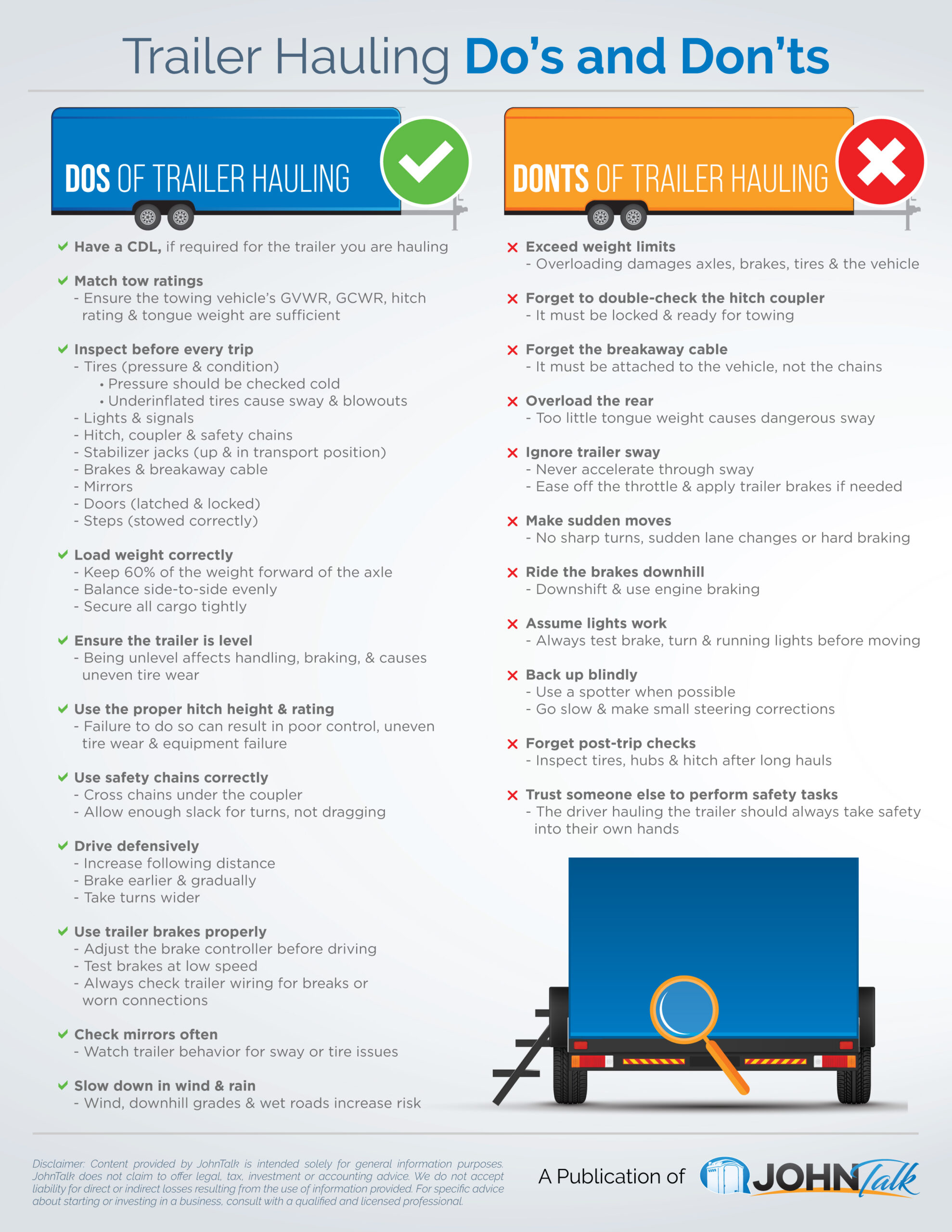
In this infographic, we list several of the dos and don’ts of trailer hauling to help you get your trailers from site to site safely.
Like this infographic? Share it with your friends and colleagues!
Get the JohnTalk “ALL-ACCESS PASS” & become a member for FREE!
Benefits Include: Subscription to JohnTalk Digital & Print Newsletters • JohnTalk Vault In-Depth Content • Full Access to the JohnTalk Classifieds & Ask a PRO Forum
Looking to Take Your Portable Restroom Business to the NEXT LEVEL? Download our FREE Guide: “Your Guide to Operating A Portable Restroom Business.”
Thinking About GETTING INTO the Portable Restroom Industry? Download our FREE Guide: “Your Guide to Starting A Portable Restroom Business.”
Trailer Hauling: Dos & Don’ts
Dos of Trailer Hauling
- Have a CDL, if required for the trailer you are hauling
- Match tow ratings
- Ensure the towing vehicle’s GVWR, GCWR, hitch rating & tongue weight are sufficient
- Inspect before every trip
- Tires (pressure & condition)
- Pressure should be checked cold
- Underinflated tires cause sway & blowouts
- Lights & signals
- Hitch, coupler & safety chains
- Stabilizer jacks (up & in transport position)
- Brakes & breakaway cable
- Mirrors
- Doors (latched & locked)
- Steps (stowed correctly)
- Tires (pressure & condition)
- Load weight correctly
- Keep 60% of the weight forward of the axle
- Balance side-to-side evenly
- Secure all cargo tightly
- Ensure the trailer is level
- Being unlevel affects handling, braking, & causes uneven tire wear
- Use the proper hitch height & rating
- Failure to do so can result in poor control, uneven tire wear & equipment failure
- Use safety chains correctly
- Cross chains under the coupler
- Allow enough slack for turns, not dragging
- Drive defensively
- Increase following distance
- Brake earlier & gradually
- Take turns wider
- Use trailer brakes properly
- Adjust the brake controller before driving
- Test brakes at low speed
- Always check trailer wiring for breaks or worn connections
- Check mirrors often
- Watch trailer behavior for sway or tire issues
- Slow down in wind & rain
- Wind, downhill grades & wet roads increase risk
Don’ts of Trailer Hauling
- Exceed weight limits
- Overloading damages axles, brakes, tires & the vehicle
- Forget to double-check the hitch coupler
- It must be locked & ready for towing
- Forget the breakaway cable
- It must be attached to the vehicle, not the chains
- Overload the rear
- Too little tongue weight causes dangerous sway
- Ignore trailer sway
- Never accelerate through sway
- Ease off the throttle & apply trailer brakes if needed
- Make sudden moves
- No sharp turns, sudden lane changes or hard braking
- Ride the brakes downhill
- Downshift & use engine braking
- Assume lights work
- Always test brake, turn & running lights before moving
- Back up blindly
- Use a spotter when possible
- Go slow & make small steering corrections
- Forget post-trip checks
- Inspect tires, hubs & hitch after long hauls
- Trust someone else to perform safety tasks
- The driver hauling the trailer should always take safety into their own hands