

The Power of Proactive Communication
February 16, 2026
How Small CX Fixes Create Big Referral Growth
March 9, 2026
If you’re new to portable toilet trailers, there’s a lot to wrap your head around. One of the important things to understand is the power needs for the trailers in your fleet. Powering a trailer appropriately ensures efficient and safe operation for the duration of its usage at the event or project.
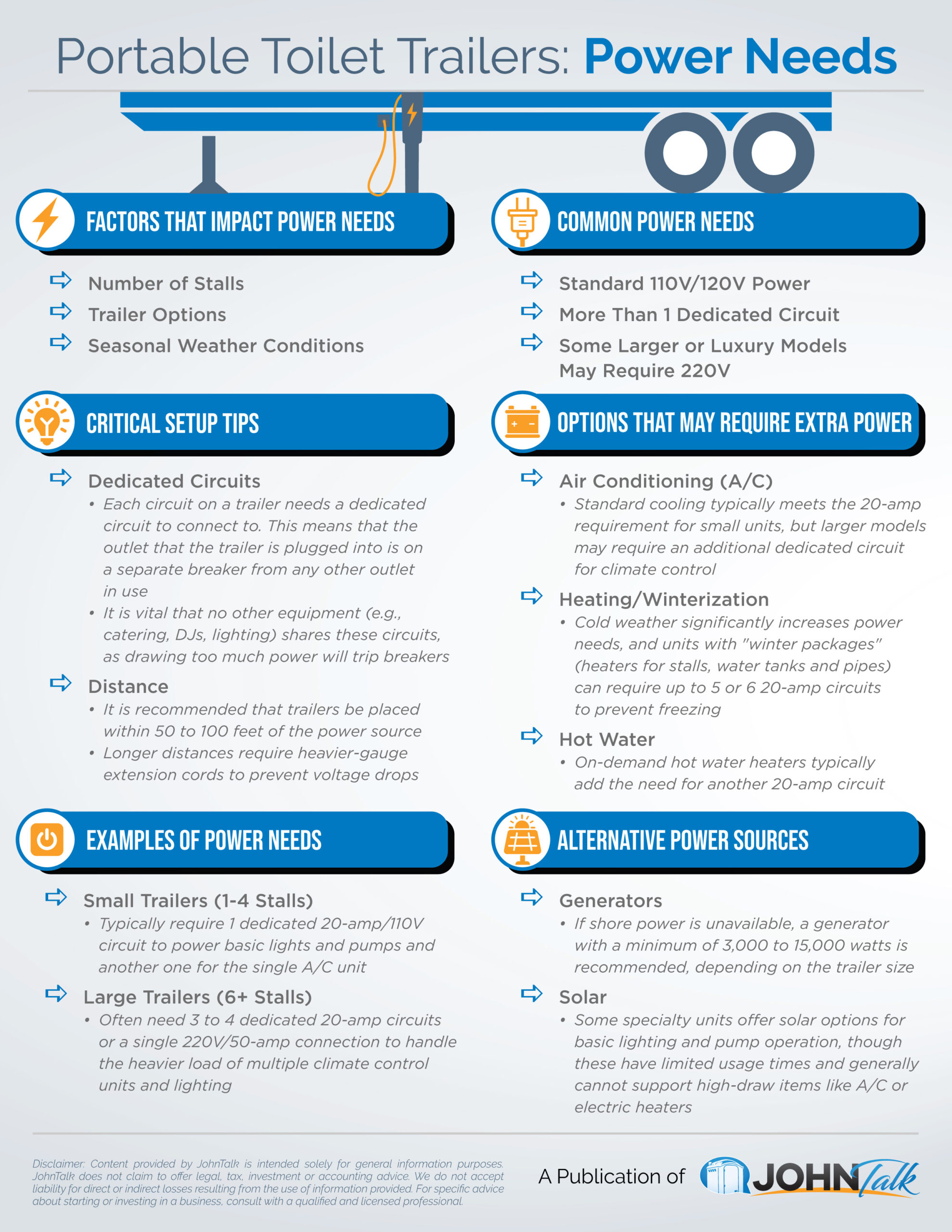
In the infographic below, we summarize the key power requirements and setup tips to help you feel more confident when answering questions from customers and setting up trailers in the field.
Information for this infographic was contributed by Keegan Campbell, of Ameri-Can.
Like this infographic? Share it with your friends and colleagues!
Get the JohnTalk “ALL-ACCESS PASS” & become a member for FREE!
Benefits Include: Subscription to JohnTalk Digital & Print Newsletters • JohnTalk Vault In-Depth Content • Full Access to the JohnTalk Classifieds & Ask a PRO Forum
Looking to Take Your Portable Restroom Business to the NEXT LEVEL? Download our FREE Guide: “Your Guide to Operating A Portable Restroom Business.”
Thinking About GETTING INTO the Portable Restroom Industry? Download our FREE Guide: “Your Guide to Starting A Portable Restroom Business.”
Portable Toilet Trailers: Power Needs
Factors That Impact Power Needs
- Number of Stalls
- Trailer Options
- Seasonal Weather Conditions
Common Power Needs
- Standard 110V/120V Power
- More Than 1 Dedicated Circuit
- Some Larger or Luxury Models May Require 220V
Critical Setup Tips
- Dedicated Circuits
- Each circuit on a trailer needs a dedicated circuit to connect to. This means that the outlet that the trailer is plugged into is on a separate breaker from any other outlet in use
- It is vital that no other equipment (e.g., catering, DJs, lighting) shares these circuits, as drawing too much power will trip breakers
- Distance
- It is recommended that trailers be placed within 50 to 100 feet of the power source
- Longer distances require heavier-gauge extension cords to prevent voltage drops
Options That May Require Extra Power
- Air Conditioning (A/C)
- Standard cooling typically meets the 20-amp requirement for small units, but larger models may require an additional dedicated circuit for climate control
- Heating/Winterization
- Cold weather significantly increases power needs, and units with “winter packages” (heaters for stalls, water tanks and pipes) can require up to 5 or 6 20-amp circuits to prevent freezing
- Hot Water
- On-demand hot water heaters typically add the need for another 20-amp circuit
Examples of Power Needs
- Small Trailers (1-4 Stalls)
- Typically require 1 dedicated 20-amp/110V circuit to power basic lights and pumps and another one for the single A/C unit
- Large Trailers (6+ Stalls)
- Often need 3 to 4 dedicated 20-amp circuits or a single 220V/50-amp connection to handle the heavier load of multiple climate control units and lighting
Alternative Power Sources
- Generators
- If shore power is unavailable, a generator with a minimum of 3,000 to 15,000 watts is recommended, depending on the trailer size
- Solar
- Some specialty units offer solar options for basic lighting and pump operation, though these have limited usage times and generally cannot support high-draw items like A/C or electric heaters