
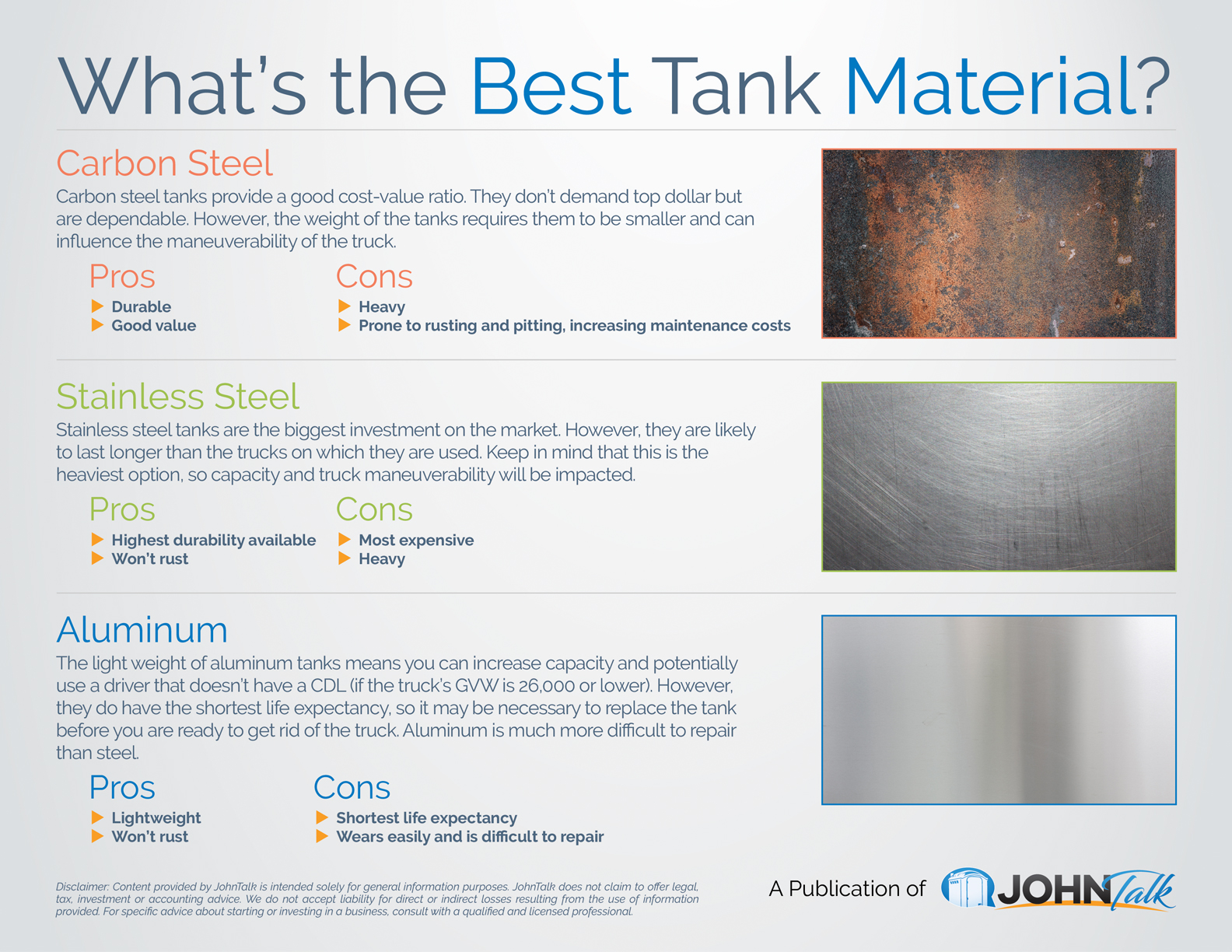
INFOGRAPHIC: What’s the Best Tank Material?
March 13, 2018
How to Bid Contracts
March 15, 2018
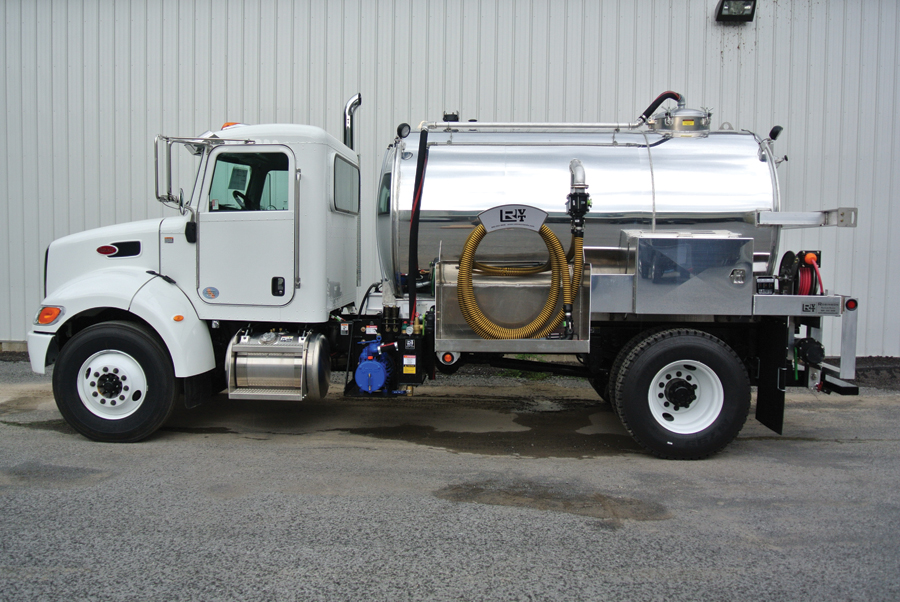
Photo courtesy Robinson Vacuum Tanks
- Robinson Vacuum Tanks – https://robinsontanks.com/
- Amthor International Tank Trucks – https://amthorinternational.com
- Best Enterprises, Inc. – www.bestenterprises.net
- Crescent Tank – www.crescenttank.com
- FlowMark – https://flowmark.com
- KeeVac Industries, Inc. – www.keevac.com
- Pik Rite, Inc. – www.PikRite.com
- Satellite Industries – www.satelliteindustries.com
A Note About Slide-In Units
A slide-in is a completely self-contained portable sanitation unit (vacuum pump, tank, etc.) that fits in a standard, full-size pickup bed or on a trailer. As an inexpensive “starter” or for small-scale operations, a slide-in unit is an economical alternative to the significant financial investment of a pumper truck. Now, let’s take a closer look at the major components of the pumper truck.Chassis
The chassis is the solid, basic foundation of your truck. It is the vehicle frame, engine, transmission, suspension, brakes, axles and tires. The chassis of the pumper truck includes the cab — the space where the driver sits. Pumper trucks usually have a conventional cab design, where the driver is seated behind the engine. Pumper truck chassis are built in makes and models to meet most any need by all the major manufacturers: Chevrolet, Dodge, Ford, Freightliner, Hino, International, Izusu, Kenworth, Mack, Mitsubishi, Peterbilt, Sterling, etc. For example, popular models are the Ford F-550, Dodge Ram 5500 and the Hino 268. The portable sanitation equipment is added to the chassis by the pumper truck manufacturers. So, when buying or leasing a truck, there are a lot of options to choose from. Of course, you may simply prefer one brand of truck over the others. Many operators make a significant investment by having their truck custom-built to their specifications, in part so they can choose their own chassis (when ordering a truck, take into account that some chassis require extra lead time to be outfitted with portable sanitation equipment). Others are fine with floor-ready models or economize by buying used. Whatever your choice, you should tailor the truck to its workload and your budget. Prices of makes and models can vary by thousands of dollars, which is why matching is critical. Don’t buy too much truck or too little truck. There are many things to consider. Do the roads on your service route have hills? Do you go off-road a lot? Do you want the capacity of a larger tank? You’ll need a heavier transmission. Do you have a lot of customer sites where there is little space to maneuver? Then a tight turning radius becomes an important benefit. Be careful not to underestimate the chassis you will need. A chassis that is too light for its workload can reduce productivity and put excessive wear on the truck. Fuel economy is often at the top of the list of reasons to buy a particular truck. Fuel is one of the largest expenses of your business. Remember, all those accessories you want (the “bells and whistles”) add weight or consume more power and cut down your mpg. Once you own your truck, tracking the truck’s operating expenses on a cost-per-mile basis will help determine how fuel impacts your business. But for many operators, the most important factor in choosing a pumper truck isn’t cost, miles per gallon, brand or accessories. It’s how easy it is to have the truck serviced. Because if your truck breaks down, your business breaks down! When your truck needs repairs, you want service that is completely trustworthy, nearby, experienced with your brand and gets you back on the road quickly. Talk to your local distributors about their after-sales service, as well as repair shops in your area.Cab
The cabin is part of the chassis, and it will be your home away from home for several hours every day. Consider comfort and safety. Is it easy to get in and out? Is it comfortable and roomy? Do you like the configuration of the dashboard? How is visibility? Will it help to have a backup camera? What amenities do you want – sound system, air conditioning, power seats, power windows, cup holders? Some operators prefer a stripped-down cab that lowers the initial purchase price. You might already be familiar with another option. Many pumper truck models offer upfitter switches. These switches connect to the electrical system of the truck and allow you to control your pump and other equipment from the cab.GVWR
An important consideration is the gross vehicle weight rating (GVWR) of your truck. GVWR is a rating of the maximum operating weight of a vehicle and is used to specify weight limitations and restrictions. Vehicles over 6,000 pounds can’t be driven on some roads. Commercial vehicles over 8,500 pounds are required to have insurance. Vehicles that weigh 26,001 pounds or more generally require a Commercial Driver License (CDL) or a Non-Commercial Class “A” or “B” license. Manufacturers list the GVW in their specs. GVW is the total weight of the vehicle and the load – including the driver, units, equipment and the weight of the waste and water you are hauling. Water weighs 8.4 pounds per gallon (waste is a little more), so a full tank will add thousands of pounds to vehicle weight. Keep the GVWR in mind when adding accessories. You can buy pumper trucks that don’t require a CDL to operate, but adding accessories or swapping out the factory-installed tank with a larger tank (carrying a heavier load) can cause your truck to exceed its GVWR. There can be large fines for violating state laws on truck weight. For an in-depth review of all state laws involving truck size and weight limit, go to https://ops.fhwa.dot.gov/freight/policy/rpt_congress/truck_sw_laws/index.htm.Get the JohnTalk “ALL-ACCESS PASS” & become a member for FREE!
Benefits Include: Subscription to JohnTalk Digital & Print Newsletters • JohnTalk Vault In-Depth Content • Full Access to the JohnTalk Classifieds & Ask a PRO Forum Click here to learn more.Fuel
Pumper.com notes in a 2017 article (“Making Sense Of Alternative Fuel Choices”) that while most pumper trucks run diesel, gasoline is a workable option. Gas is available for Class 7 (33,000 lbs. GVWR) and smaller and is best suited to low-mileage applications of 25,000 miles or 600 hours or less per year. Advantages of gas:- Total cost of ownership is less due to the reduced purchase price and maintenance costs
- Gas is readily available
- No special requirements in handling fuel
- Simple, reliable emission system
- Reduced downtime; many repair shops
- Requires higher rpm to generate torque
- Less mpg
- More frequent maintenance
- Limited PTO applications
- Not environmentally friendly
Tank
The storage tank, with all its features, options, and the equipment and accessories that go with it, makes up a complex system that is engineered to make servicing portable toilets and storing and dumping waste as convenient and efficient as possible. Your budget, the size of your business and the length of your route should be the main reasons you choose certain tank options over others. With many tank systems available from several leading manufacturers, you should be able to find the ideal one. To begin, let’s look at the tank itself. Tanks are made from three materials: carbon steel, stainless steel and aluminum. Each type has excellent advantages, as well as certain drawbacks. Carbon Steel Pros:- Durable, lasts a long time
- Good price value
- Heavy weight
- Prone to rusting and pitting, requiring more maintenance
- Most durable and longest lasting
- Won’t rust
- Weighs the most
- Costs the most
- Lightest weight of the three
- Doesn’t rust
- Shortest life expectancy
- Shows wear easily
Tank Load
The tank is placed on the chassis so weight is distributed evenly. Your tanks should have baffles or a baffle system inside. Baffles are partitions that deflect the motion of the fluid (the “surge load” or “slosh load”). Let’s say you have 500 gallons of waste in your tank. At about 9 pounds per gallon, the total weight is about 4,500 pounds. When you start moving, that’s more than two tons of liquid sloshing back toward the rear of the tank. When you brake, the liquid flows toward the front of the tank. When you turn, it flows sideways. The force is hard on your engine, hard on your brakes and hard on your truck. Baffles are a welcome safety and control feature. (However, they do add to truck weight.)Tank Size
Tank size is an important consideration. There is a great variety of tank sizes. You’ll see tanks as small as 300 gallons and as large as 4,000 gallons. A common tank size is 1,000 to 1,500 gallons, but again, you should size your tank to your needs. How many units will you service? One standard portable toilet has a waste tank volume of about 60 gallons. Operators are trending toward larger tanks. You gain storage, which means you save time and money making fewer trips to dump sites. But you give up some maneuverability and can expect reduced fuel economy due to the extra weight. Make sure you have enough truck to carry the load but stay within your weight limit. The manufacturer or distributor will work with you to make sure the vacuum pump is properly sized to your tank.Tank Compartments
- Waste compartment
- Freshwater compartment
- Vacuum inlet valve
- Discharge outlet valve
- Manway
- Primary shut-off
- Level indicators
Work Station & Accessories
- Side cabinet(s)
- Toolbox(es)
- Hose and hose reel
- Bucket fill/bucket holder
- PTO controls (optional)
- Pressure wash system (optional)
Pump
The vacuum pump is the powerhouse of your portable sanitation operation. Pumps generally have a rotary vane design and are either powered by a gasoline engine or a PTO (power take-off) system. PTOs attach to the truck transmission and transfer the power of the engine to the vacuum pump. As mentioned earlier, some pumps can be set to reverse, or “pressure,” to help gravity force out the waste. If you don’t know a lot about pumps, let the truck manufacturers do the work for you. When you buy a pumper truck built by any of the major manufacturers, it will feature a rugged, high-performance pump that has been properly sized according to the capacity of the tank. You may prefer to buy a truck with a certain make of pump. There are also manufacturers that will custom-build your truck, allowing you to select the pump of your choice. You can compare specs from pump manufacturer websites, and contact the company or local distributor for technical support. Some of the major pump manufacturers are:- Masport (masportpump.com)
- NVE (National Vacuum Equipment) (https://natvac.com/)
- Fruitland Manufacturing (fruitlandmanufacturing.com)
- Jurop (https://www.jurop.it/en/home)
- Battioni (https://www.bapag.it/en-US/battioni-pagani-pompe—parma.aspx)
- Moro (http://www.morousa.com/Vacuum-Pumps/)
- Westmoor, Ltd. (Conde pumps) (westmoorltd.co)
- Chandler (https://chandlerequipment.com)
The End-Unit Holder & Rear Hitch
The pumper truck efficiently uses its space right to the very end. In many models, the back end of the truck is mounted with a reinforced 2-unit toilet rack. A few can even hold four. The typical liftgate gives the operator easy access to the units. If you’ll be carrying toilets, store a dolly on your truck. Look for a model that includes a trailer hitch mount if you want to haul even more units. Many pumper truck models add one more feature – the license plate holder! And don’t forget work lights, because we all know that after you buy the truck you’re likely to be working all hours — day and night!Looking to Take Your Portable Restroom Business to the NEXT LEVEL? Download our FREE Guide: “Your Guide to Operating A Portable