

How to Get Started in Shower Trailers
June 15, 2026

Why stocking for your peak day is the most expensive habit in this industry, and how to think about inventory and utilization without selling yourself short.
It was early spring. I had the 2026 inventory plan in front of me and the cursor hovering over the order button.
Eighteen new special event units. Around $16,000. The math made sense. We’d had a busy summer the year before, the busiest weekend hit our fleet hard, and I’d added a small buffer for growth on top of that. That’s how most of us buy inventory. Look at last year’s peak, add a little for growth, hit send.
Then, I stopped.
This was the year we’d promised ourselves we’d be more data-backed in how we made decisions. I’d been telling my team that all winter. And here I was about to drop sixteen grand based on the same gut-feel logic I’d used every other year. So, I told the team to hold the order. Give me a few hours.
I went down the rabbit hole. Pulled every event delivery from the past season. Plotted daily unit-count in use across the entire summer. I’m a visual guy. Numbers in a table never quite land for me the way a chart does, and the team picks it up faster, too.
What I saw stopped the order cold.
Our existing fleet had covered every single day of last season except one. The second-busiest day of the entire year sat comfortably inside what we already owned.
One day. Out of an entire season. And that one day wasn’t even a normal pattern. It was a single 40-unit client order that landed on top of an already-busy weekend. A fluke. Not a trend.
I was about to spend $16,000 to solve a one-day problem.
A trap most of us have fallen into
Most operators buy inventory by feel. We look at last year’s peak, we add some growth, we order. And it feels responsible. We’re planning ahead, we’re not getting caught short. The logic goes like this: running out of units in your best month is the worst sin in the business. You turn away a $5,000 event, you lose the customer to a competitor, and they might not come back next year. So, we overcorrect. We stock for the peak, not the pattern.
And I should know, because I’ve done the opposite of what I’m about to recommend. The year before this, we had close to 100 event units on the lot. Turns out, we didn’t really need most of them based on how the season actually played out. They let us take on one large event we wouldn’t have otherwise been able to handle. But the capital sitting in the yard the other fifty weeks of the year? Hard to justify in hindsight.
Here’s the thing nobody puts on the spreadsheet when they’re sizing up a buy:
- Yard real estate, which isn’t free, especially if you’re renting.
- Graffiti, repairs, and light maintenance even on units that aren’t earning.
- Capital tied up that can’t go toward a new truck, a hire, or a marketing push.
The question we should be asking isn’t “would I rather run out?” It’s “what’s the actual cost of running out one weekend a year versus carrying capacity I’ll basically never use?” Most of the time, when you put those two costs side by side, honestly, the math flips.
What other rental industries figured out before we did
Here’s where it gets interesting. Every other major rental industry has already solved this problem. We’re a little behind, and there’s no shame in borrowing from them.
Hotels. Nobody builds a 200-room hotel for the one weekend a year that would sell out. The big chains build for the 80th or 85th percentile occupancy day and let the rare peak get turned away or referred to a sister property. The whole field of hotel revenue management starts from the assumption that some unsold capacity is fine. It’s the price of not carrying dead weight the rest of the year. A unit sitting empty in your yard on a peak Saturday is the same problem they solved decades ago.
Car rental. During peak holiday demand, the major rental companies routinely rent cars from each other rather than buying a fleet that only earns for one week a year. They’ve reframed subcontracting as a tool, not a failure. We can do the same. There’s nothing weak about referring an overflow event to another operator in town. You keep the customer relationship, you don’t carry the units, and most of the time, the operator returns the favor when they’re overflowing.
Both industries decided long ago that stocking to the peak day is a rookie move. Portable sanitation is one of the few corners of the rental world still working it out.
Inventory and utilization are not the same thing
This is the distinction that nobody explained to me when I started, and it cost me money for years.
Inventory is what you own. The count of units sitting in your yard, on a job, or in transit. It’s a static number you can write on a whiteboard.
Utilization is what’s earning. The percentage of your inventory that’s actually on a rental at any given moment. It’s a live number that moves every day.
They are wildly different things, and confusing them is how you end up with capital tied up in idle equipment.
Quick example. An operator with 100 units running at 60% utilization is earning revenue on 60 units. An operator with 60 units running at 100% utilization is also earning revenue on 60 units. Same revenue line, but the 100-unit operator is paying carrying costs on 40 idle units. The 60-unit operator is more profitable. That’s the insight that should make every operator stop and look at their fleet differently.
One more wrinkle: events and construction are completely different stocking problems. Construction units sit on a site for weeks, so the question is total volume: how many are out at once across the whole network over a stretch of months. Events are short, jammed into a Friday-to-Monday window, so the question is concurrency: how many you need out at the same time on the busiest weekend. Same business, two different math problems. If you’re using one approach for both, one of them is wrong.
How to actually run a utilization report (without being a data nerd)
The good news: you almost certainly already have the data. It’s sitting in your dispatch software or your invoicing system. You just haven’t pulled it the right way.
Here’s the simplest version that gets you 90% of the insight:
For every rental you delivered last year, you need three columns: date out, date back, and product type. That’s it. From those three columns, you can build the chart that changes how you think about your fleet.
The chart I’m talking about is the one below. It’s the daily count of units in use across the season, what I plotted when I stopped that order. The shape will probably surprise you.
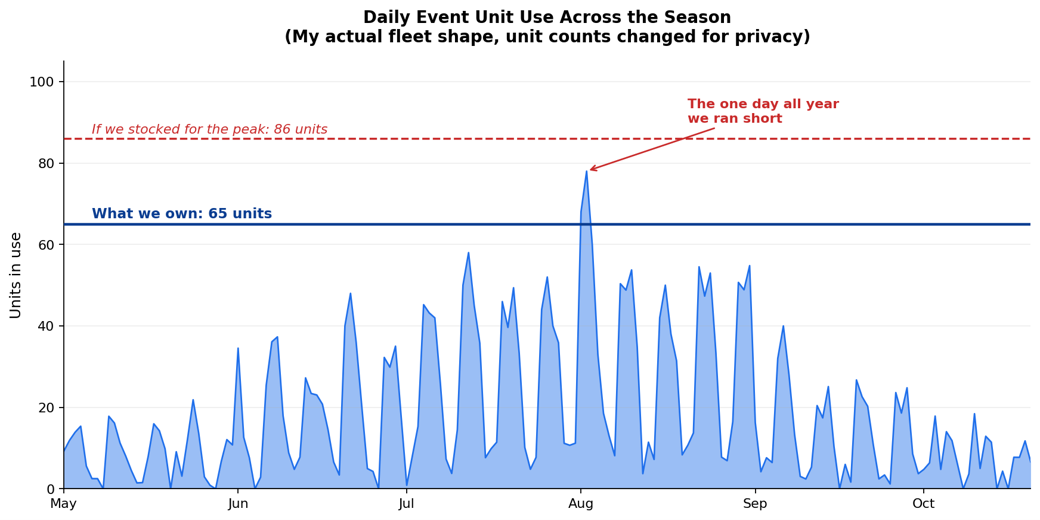
Daily units in use across my own event season. The unit counts have been changed for privacy, but the seasonality closely mirrors my real business, and any operator in a northern or strongly seasonal market will recognize the shape immediately. A fleet of 65 covered every day of the year except one. The chart, not the spreadsheet, is what makes the lesson land.
What you’re looking for on your own chart is three things:
- The busiest day. Your peak. The spike everyone remembers.
- The second-busiest day. This is the one that actually matters. If your current fleet comfortably covers the second-busiest day of the year, you almost certainly don’t need to stock to the first.
- The outlier check. Was your peak driven by one weird booking, like a single big customer, a one-off event, or a freak weekend that won’t repeat? If yes, throw it out of the planning math. Stocking to a fluke is how you end up with idle inventory.
And here’s what the shape of your chart actually tells you about your business. Most operators have one of these patterns, and they each call for a completely different response:
| If your chart looks like… | What it means and what to do |
| A single tall spike, then much lower the rest of the year | Don’t stock to it. The spike is a fluke. Subcontract overflow or turn it away. Buying for one day is the most expensive move in this business. |
| A tall spike with several near-misses just below | Real demand pattern. Worth modeling whether 4-6 more units would have earned the 6-weekend threshold across those near-misses combined. |
| Flat across the summer at or near your fleet ceiling | You’re under-fleeted and probably turning work away you don’t even know about. Talk to your sales team about lost quotes. This is when you actually should buy. |
| Healthy ramp up, plateau, and ramp down | Textbook seasonality. You’re sized right. Focus your energy on filling the shoulders, not on the peak. |
If you don’t want to do this in Excel, you don’t have to. Drop your data into any AI tool and ask it the question directly. A prompt that works:
Here’s my rental data for [product] from [date range]. Columns are date out, date back, product type. Build me a chart of how many units were in use each day across the season. Tell me my busiest day, my second-busiest day, and the average day during my peak month. Flag any single days that look like outliers or one-off events.
That prompt will get you a working chart in about thirty seconds — no spreadsheet skills required. You’ll see your season the way you’ve never seen it before.
The real question to ask before you buy
Once you have the chart, the next question is the one we don’t usually ask ourselves out loud:
How many days a year would this new unit actually be earning?
Let’s put real numbers on it. Take an event unit in the US market: roughly $900 to buy, $150 average weekend rental, seven-year useful life, around $90 per year in carrying costs for repairs, graffiti removal, and the rest (your number will vary by market, so adjust as needed). Here’s what a new unit has to do to justify itself:
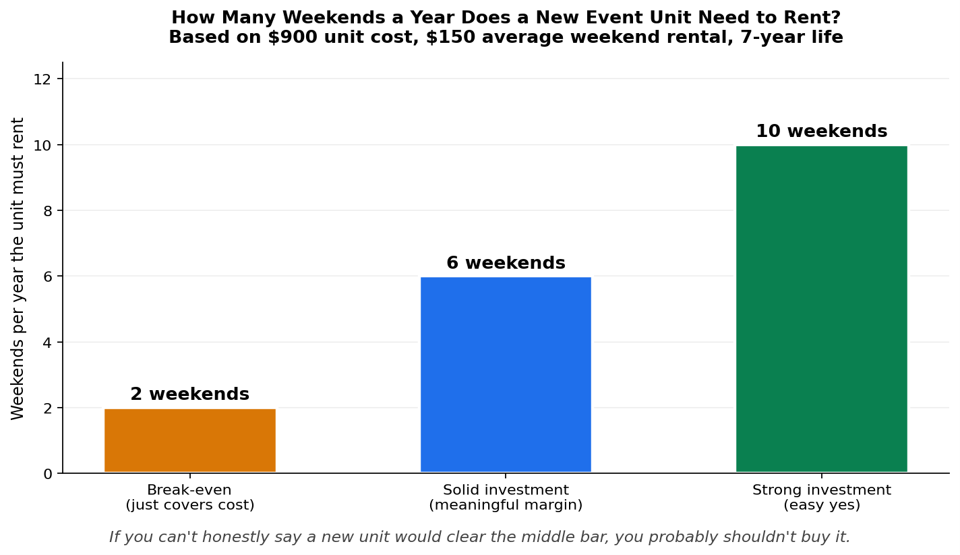
Roughly 2 weekends a year just breaks even on the cost of ownership. Around 6 weekends gets you meaningful margin contribution. 10+ weekends is a clear yes. If a unit won’t clear 6, you’re better off not buying it.
Six weekends. That’s the bar, and it’s not a high one. The 18 units I almost bought? They would have earned exactly one weekend last year. One. Not 6, not 10. One.
The trap most operators fall into is running only the upside half of that math. You imagine the revenue from never turning away a job. But you don’t run the other half: what those units cost you the other fifty weeks of the year when they’re sitting in the yard. Force yourself to look at both numbers side by side. The decision usually makes itself.
The same chart fixes a problem you didn’t know you had
Here’s the part most operators miss: the daily-use chart isn’t just an inventory tool. It’s the single most useful alignment tool you can hand your sales, marketing, finance, and ops teams. Once everyone is looking at the same chart, a whole set of friction points across the business start dissolving. Your chart is telling you exactly when you have capacity to win new work, and exactly when you don’t. That’s a goldmine, and almost nobody uses it that way.
Marketing spend follows the gaps, not the peaks. If your chart shows mid-August running at 95% of fleet capacity, why are you running ads that month? You can’t service the leads you already have. Pull that spend and push it into the shoulder months (late May, mid-June, September) where the chart shows you have units sitting idle. Same annual budget, much flatter utilization curve, more revenue.
Sales gets clarity on when to be aggressive and when to hold the line. If your salesperson knows the first two weekends of August are constrained and the last two weekends of September are wide open, they can quote differently. Firm pricing on constrained weekends. More aggressive pricing, bundled extras, or longer rental incentives on the open ones. Without the chart, every quote is treated the same, and you either leave money on the table during peaks or turn away discounted work you could profitably take in the shoulders.
Finance stops fielding the wrong asks. When an ops manager comes to finance in March saying “we need to buy 18 more units for August,” finance has no way to push back without the chart. With it, the conversation changes: do we spend $16,000 on units that earn one weekend, or put $5,000 of that into shoulder-season marketing and pocket the rest? Different question, different answer.
Ops stops getting buried. Nothing burns out an operations team faster than sales booking a huge weekend on top of an already-constrained Saturday because nobody told them the fleet was tapped. Share the chart with ops, and they have a basis to push back before dispatch decisions spiral.
The teams that work this way grow faster, hire less reactively, and stop spending capital on inventory they don’t need.
Get the JohnTalk “ALL-ACCESS PASS” & become a member for FREE!
Benefits Include: Subscription to JohnTalk Digital & Print Newsletters • JohnTalk Vault In-Depth Content • Full Access to the JohnTalk Classifieds & Ask a PRO Forum
What to do with units you already own that aren’t earning
So, what if you’ve already over-bought? Or, what if you’ve got a chunk of fleet that’s clearly underutilized and you’re not ready to sell it off? A few things actually work:
- Push into shoulder-season construction work. A unit on a long construction job is earning every week, even at a modest duration discount. And if some of your event-fleet units can be repurposed onto construction sites in the off-season, do it. A unit earning at a construction rate is still earning. It’s not chewing through capital sitting in the yard.
- Subcontract to other operators during their peak. Another operator in town overflowing on a Saturday? Rent units to them at a wholesale rate. They cover their customer, you earn on units that would have been idle, and the next time the situation is reversed, they’ll return the favor.
- Chase the off-season event categories you currently say no to. Film shoots, corporate events, municipal work, off-season festivals. The work exists; most operators just don’t pursue it because summer is profitable enough.
None of these will turn a 40-unit overbought fleet into a money-maker overnight. But they can move the needle from “capital is bleeding” to “capital is at least breaking even” while you wait out the natural fleet turnover.
When the answer actually is buy
I don’t want this article to read as anti-buying. There are absolutely times when the answer is to expand the fleet. Construction is the obvious case. Construction units sit on sites for weeks or months. Demand grows roughly linearly with sales. If your construction utilization is over 85% during your busy months and you’re turning away job sites, buy. You’re leaving money on the table.
Here’s the simple test:
If a new unit would have been on a job for more than 60 rental days last year, buy it. If less than 60, don’t.
For construction, 60+ days is a strong investment. That’s the equivalent of around two months of deployment, which most growing operators easily hit on a single site. For events, the equivalent threshold is 6+ rental weekends, as we just saw.
The point isn’t to never buy. The point is to know which side of the line you’re on before you sign the purchase order. Buying the wrong units is expensive. Not buying the right units is also expensive. Knowing the difference is the whole job.
Takeaways
- Inventory is what you own. Utilization is what’s earning. Don’t confuse them. The most profitable operators in any rental industry maximize utilization, not inventory.
- Stock for your second-busiest day, not your busiest. The single biggest day of the year is almost always a fluke. Stocking to it means carrying capacity that earns once.
- Run the chart, not just the number. A utilization percentage tells you very little. A daily-use chart across the season tells you everything you need to know.
- Use the 6-weekend rule for events and the 60-day rule for construction. Before any inventory purchase, ask honestly: would this unit clear the bar last year?
- Share the chart with marketing, sales, finance, and ops. It stops being an inventory tool and becomes a planning tool. Same season, same picture, four teams aligned.
- The cheapest unit you’ll ever own is the one you didn’t buy. Sometimes, the best inventory move is the one you decide not to make.
Those 18 units never got ordered. The money stayed in the business. We covered every day of this season with the fleet we already had, just like the chart said we would. And on the rare weekend we did get tight, we either turned away a piece of overflow or subcontracted it to another operator in town. The customer still got served. The capital still got to work somewhere more useful. The data is sitting there in your dispatch software. The chart takes an afternoon. The decision pays for itself the first time you decide not to buy units you didn’t really need.
Looking to Take Your Portable Restroom Business to the NEXT LEVEL? Download our FREE Guide: “Your Guide to Operating A Portable Restroom Business.”
Thinking About GETTING INTO the Portable Restroom Industry? Download our FREE Guide: “Your Guide to Starting A Portable Restroom Business.”