

How to Place Bids for Canadian Government Contracts
March 23, 2026
How Canadian Manufacturers are Strengthening Portable Sanitation Supply Chains
April 6, 2026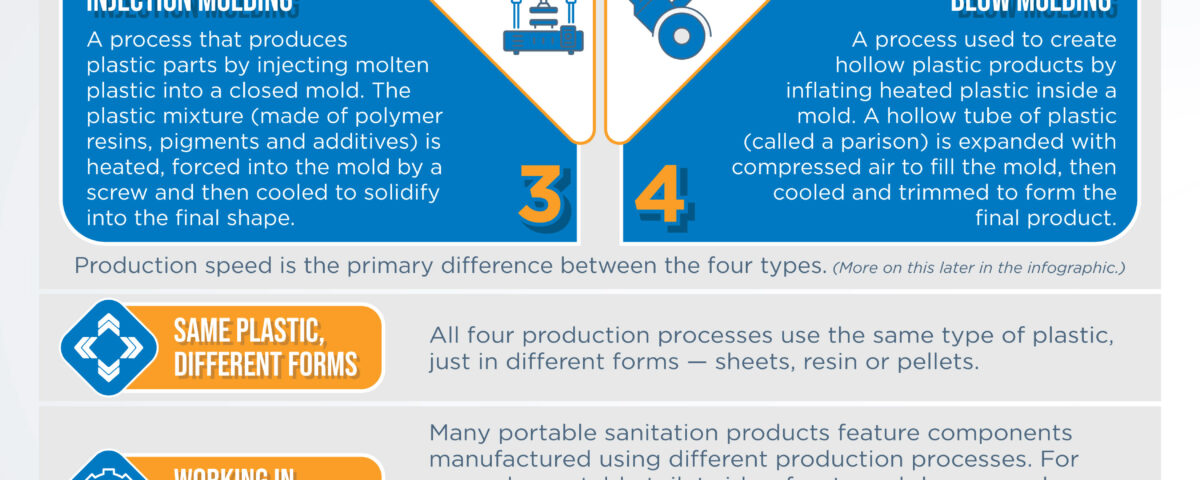
As a consumer, it can be important to know not just where the products you buy come from but also how they’re made. This is especially true for portable restroom operators (PROs), who spend big money on products and equipment for their businesses.
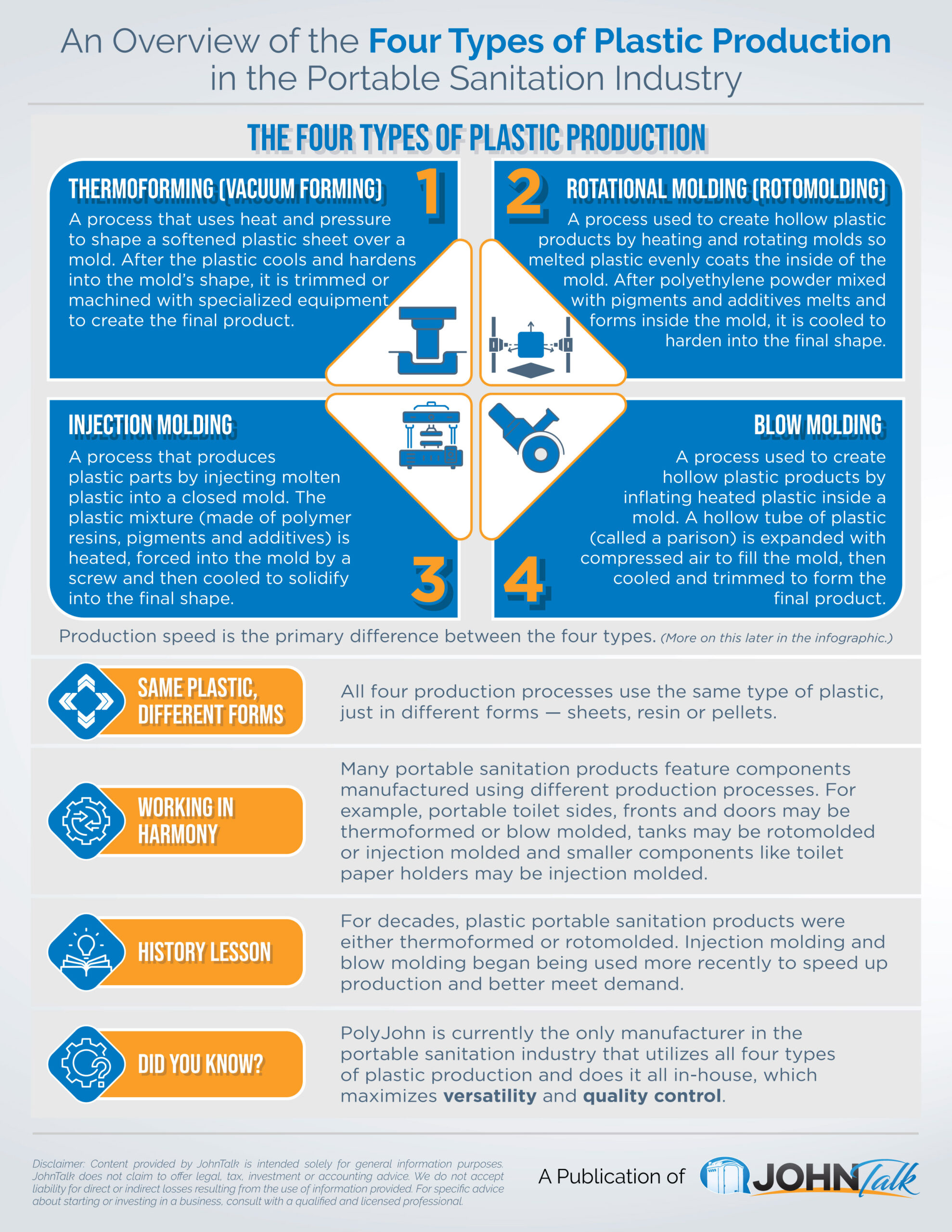
In the portable sanitation industry, there are four types of plastic production. In the infographic below, we summarize each of them and explain how they differ, as well as how they complement each other.
Like this infographic? Share it with your friends and colleagues!
Get the JohnTalk “ALL-ACCESS PASS” & become a member for FREE!
Benefits Include: Subscription to JohnTalk Digital & Print Newsletters • JohnTalk Vault In-Depth Content • Full Access to the JohnTalk Classifieds & Ask a PRO Forum
Looking to Take Your Portable Restroom Business to the NEXT LEVEL? Download our FREE Guide: “Your Guide to Operating A Portable Restroom Business.”
Thinking About GETTING INTO the Portable Restroom Industry? Download our FREE Guide: “Your Guide to Starting A Portable Restroom Business.”
An Overview of the Four Types of Plastic Production in the Portable Sanitation Industry
The Four Types of Plastic Production
- Thermoforming (Vacuum Forming) – A process that uses heat and pressure to shape a softened plastic sheet over a mold. After the plastic cools and hardens into the mold’s shape, it is trimmed or machined with specialized equipment to create the final product.
- Rotational Molding (Rotomolding) – A process used to create hollow plastic products by heating and rotating molds so melted plastic evenly coats the inside of the mold. After polyethylene powder mixed with pigments and additives melts and forms inside the mold, it is cooled to harden into the final shape.
- Injection Molding – A process that produces plastic parts by injecting molten plastic into a closed mold. The plastic mixture (made of polymer resins, pigments and additives) is heated, forced into the mold by a screw and then cooled to solidify into the final shape.
- Blow Molding – A process used to create hollow plastic products by inflating heated plastic inside a mold. A hollow tube of plastic (called a parison) is expanded with compressed air to fill the mold, then cooled and trimmed to form the final product.
Production speed is the primary difference between the four types. (More on this later in the infographic.)
Same Plastic, Different Forms
All four production processes use the same type of plastic, just in different forms — sheets, resin or pellets.
Working in Harmony
Many portable sanitation products feature components manufactured using different production processes. For example, portable toilet sides, fronts and doors may be thermoformed or blow molded, tanks may be rotomolded or injection molded and smaller components like toilet paper holders may be injection molded.
History Lesson
For decades, plastic portable sanitation products were either thermoformed or rotomolded. Injection molding and blow molding began being used more recently to speed up production and better meet demand.
Did You Know?
PolyJohn is currently the only manufacturer in the portable sanitation industry that utilizes all four types of plastic production and does it all in-house, which maximizes versatility and quality control.